

Arduino vs Raspberry Pi: A Detailed Comparison
When it comes to choosing a unmarried-board calculator, Arduino and Raspberry Pi are the big names that you'll be considering. But which one should you choose? What is the Arduino best used for? What are the drawbacks of using a Raspberry Pi? And how do you determine between the ii? It can be a tough decision, so we'll suspension it down here for you lot.
For the purposes of this article, I'll exist discussing the Arduino Uno R3 and the Raspberry Pi 2 Model B. There are many versions of both boards, and there are plenty of alternatives to the Pi and the Arduino that provide different specs and capabilities, but these two are the mainstays of each line at the moment.
Arduino Vs Raspberry Pi
Full general Purpose
While both the Arduino and the Raspberry Pi are very versatile niggling machines, they both have specific things that they're practiced at.
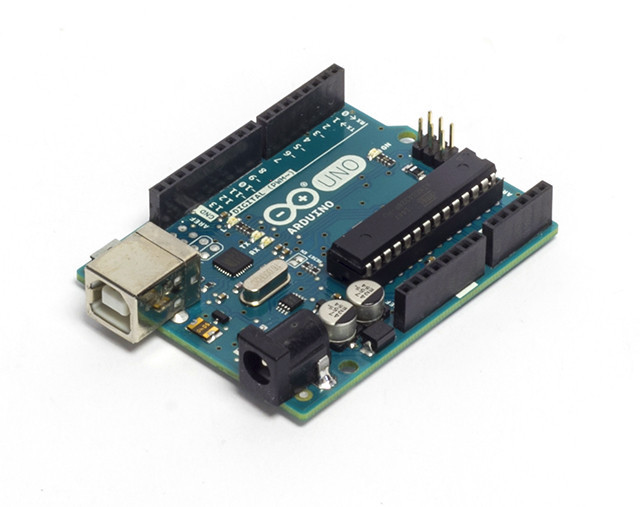
The Arduino, for instance, is a microcontroller, which means it excels at controlling minor devices like sensors, motors, and lights. This is why the Arduino is best used for projects like edifice a wake-up light, move detector warning, or even a small robot. Yous'll besides hear people talk virtually "prototyping" with an Arduino, which is the procedure of quickly creating a prototype electronic device. If the prototype is successful and the device works, it tin can exist made on a larger scale with printed circuit boards.
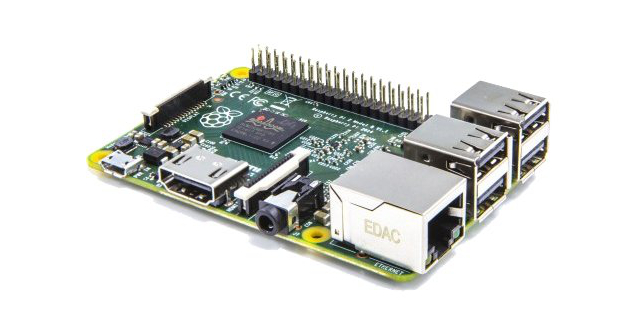
The Raspberry Pi, on the other hand, isn't a microcontroller, and isn't fabricated for controlling sensors and other things like that. Information technology's an entire computer, with its own operating organization, and is intended to exist used as 1. The operating organization is rather minimal, so you'll need some coding knowledge to get the virtually of it, but that'due south 1 of the things the Raspberry Pi is great at: helping people learn to code. Information technology'due south besides really good at acting as a server: it tin communicate with other computers, serve as an alternative to a Chromecast, provide data, and log information.
1 redditor put it perfectly: "My Pi is better at talking to people (running a spider web server). My Arduino is meliorate at talking to auto parts (moving motors)."
Hardware
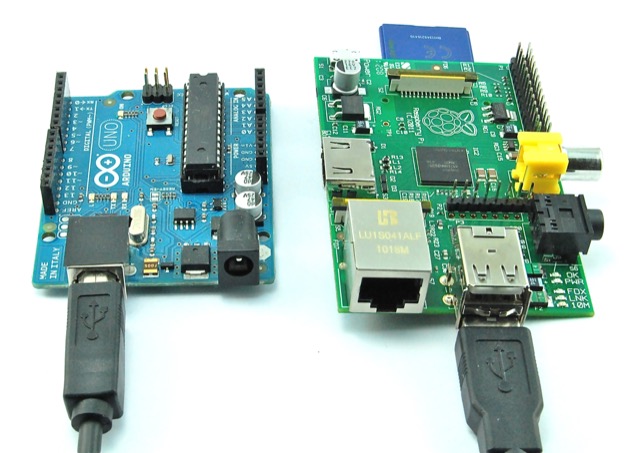
When you look at an Arduino next to a Raspberry Pi, information technology's very clear that the hardware differs quite a scrap betwixt the two. Let'south pause it downwards.
Ability
The Arduino's power supply requirements are very elementary; yous tin can plug it into your computer or a battery pack, and it volition showtime running code immediately. If the ability is disconnected, it volition stop; there's no need to run a shut-down process. The Raspberry Pi, on the other mitt, because it has a more full-featured computing system in identify, should be shut down like a regular computer, and can be damaged by power cuts.
Both the Arduino and the Raspberry Pi have a very low power draw, and can exist run for a very long time without using much electricity.
Connectivity
The Raspberry Pi comes ready to be connected to the net; it has a congenital-in ethernet port, and information technology'south very easy to get a USB wifi dongle to give it wireless connectivity as well (yous can see a very tiny 1 in the paradigm beneath). This is one of the reasons why the Pi is the device of choice for things like personal web servers, printer servers, and VPNs.
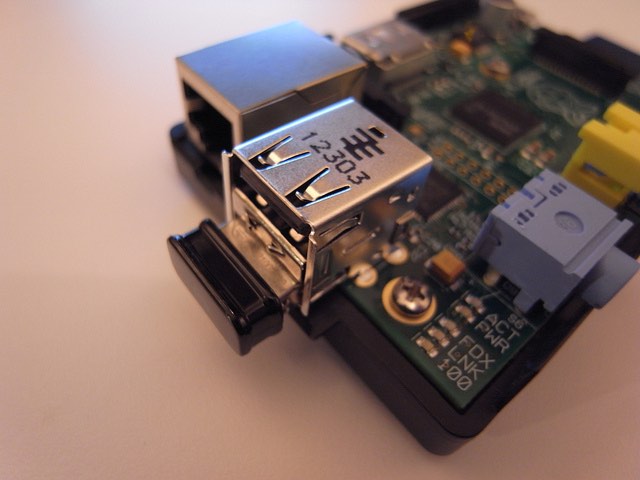
The Arduino, on the other hand, doesn't have whatever built-in capability for connectivity. If you want to connect information technology to the net, y'all'll need to add an extra slice of hardware that includes an ethernet port. If you want wifi connectivity, you lot'll need a unlike piece of hardware again. Considering the Arduino is meant for hardware projects instead of software ones, it needs a bit of tinkering to get information technology connected.
I/O Pins
Input/output pins are what let your unmarried-lath computer to talk to things that are connected to information technology. For example, your Raspberry Pi could low-cal up an LED. Or your Arduino could activate a motor. If you're looking for hardware connections, these pins are what you need. The Raspberry Pi ii packs 17 of these pins, while the Arduino Uno offers twenty; you can see a number of them being used in the paradigm below.
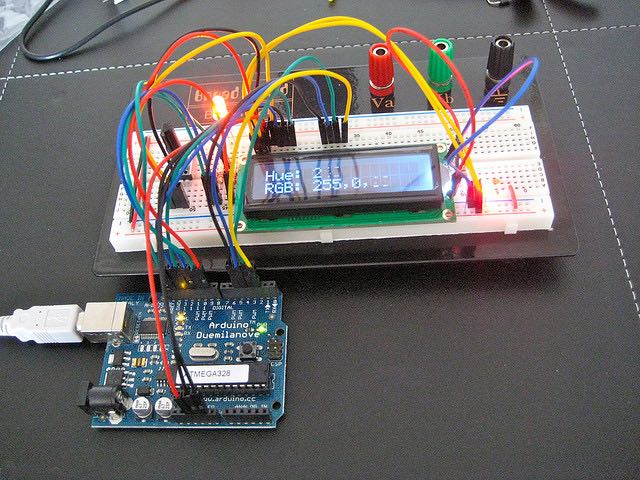
Another significant difference in the I/O pins between the two boards is the temporal resolution at which you can control them. Because the Raspberry Pi is a full computer, information technology has a number of things that are vying for CPU time, which means it can have some difficulty in getting timing down to small fractions of a 2nd. And it needs software to properly interface with sensors and other devices. The Arduino, on the other mitt, can alter the output and monitor the input on its pins down to a very tiny amount of fourth dimension.
Storage
The Arduino comes with 32 KB of onboard storage, which is just enough to store the code that provides instructions for its current program. You can't utilize this storage for apps, videos, photos, or anything else. The Raspberry Pi, on the other paw, doesn't come with any onboard storage, simply information technology does have a micro SD port, and then you lot tin add every bit much storage equally you'd like. Calculation 32 GB of storage will but cost y'all effectually $12 with a SanDisk micro SD card, and y'all can easily add upward to 128 or 256 GB if y'all demand it.
USB
Because the Arduino isn't meant to communicate with computers, information technology doesn't come standard with any USB ports that you can employ for this type of communication. A single port tin can be used to connect the Arduino to your estimator via your computer's USB port, only that'southward it. The Raspberry Pi, on the other hand, has four USB ports that you tin can use to connect it to a router, a printer, an external hard drive, or a broad multifariousness of other devices.
Software
Now that nosotros've laid out the differences betwixt the hardware of the Arduino and the Raspberry Pi, nosotros can talk about software. To really understand when you'd desire to use one lath or the other, you'll need to know what each one tin canpractise, and a lot of that is dependent on the software.
To complicate the event, the Arduino doesn't come with any software per se. It has very basic capabilities to translate the code that it receives and alter the functions of the hardware that information technology's continued to, only the board doesn't have an operating system or whatsoever sort of interface besides the Arduino integrated development environment (IDE).
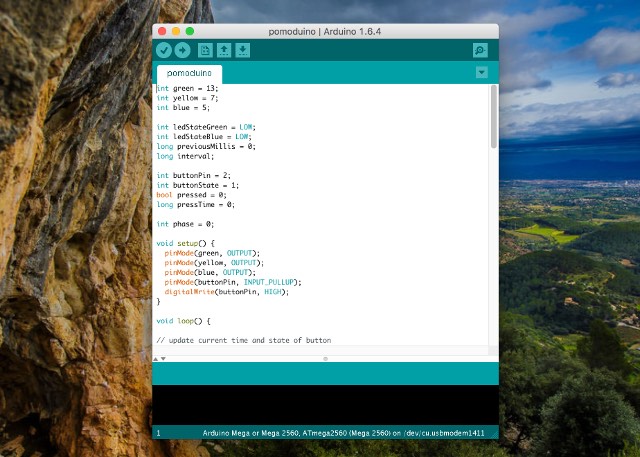
What this ways in practise is that you need to create the software that runs on the Arduino. Using the IDE, you'll create a set up of commands that the Arduino will translate and enact. A simple gear up of instructions could say something like "turn the red light on for three seconds, plough it off, plough the green lite on for three seconds, plough it off, repeat." Obviously, you lot tin exercise much more complicated things, but y'all'll still need to create the programme yourself.
Fortunately, there'due south a huge Arduino community that spans the entire world, which means that if there's something you desire to exercise with an Arduino, someone has probably washed information technology. You can look at their code, change it, and make your Arduino do exactly what you want. This is a keen way to larn the principles of coding and prototyping, every bit well, which is why the Arduino is a great choice for anyone interested in electronics.
In contrast, the Raspberry Pi comes stocked with a fully functional operating system chosen Raspbian. This OS is based on Debian Linux, and was created specifically for the Pi. In that location are a number of other operating systems that you lot can use with the lath, most of which are Linux-based, merely Android can also be installed.
Operating systems aren't the only pieces of software that the Pi runs, though; at that place are also a number of useful apps that you can use to accomplish different tasks. One of the most common uses of a Raspberry Pi is every bit a media server, for which both Kodi and Plex are popular apps. You can download games, server applications, calculators, and fifty-fifty the LibreOffice office suite.
Of course, you can write your own programs for the Raspberry Pi equally well, and that's one of the best reasons to become i: to learn to code. Python is the recommended language for the Pi, simply C, C++, Coffee, and Ruby are all pre-installed on the board. While Arduino tin be tweaked to support other languages, the native Arduino language is the best choice; if you're looking to learn a more than useful language, the Pi will give you more options.
Expanding Onward
Both the Arduino and the Raspberry Pi are very capable little machines that can help you learn and do a lot of things, but at some betoken, yous're probably going to desire to move beyond the basics and endeavour something a little more advanced.
This is i of the places where the Arduino shines. There are hundreds of chips that let you aggrandize the capabilities of the stock board with things like ethernet and wifi connectivity, better motor control, speaker and microphone capabilities, a touchscreen, cameras, radio transmitters, graphics processing, and almost anything else yous can think of. For $twenty to $twoscore, you can plow your Arduino into something else entirely (like this Adafruit GPS shield).
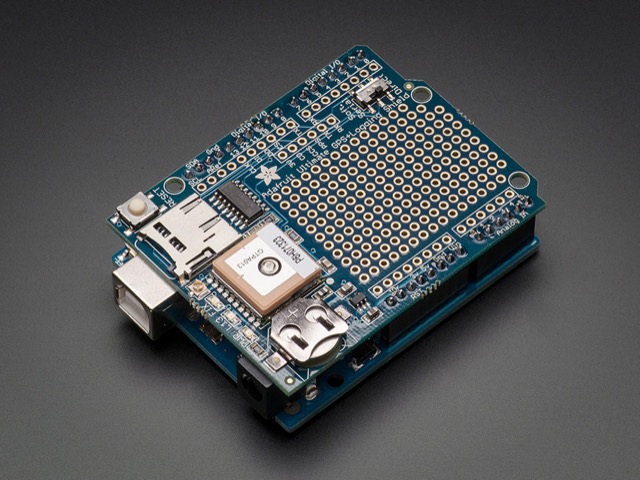
These chips are called shields, and are very easily installed; all you do is identify them on top of your Arduino and—in some cases—solder them in identify. Many tin but sit on meridian, making installation a breeze.
The Raspberry Pi is a more self-contained board, and doesn't have the same expansion capabilities as the Arduino. At that place are a number of "hats" available that add together additional hardware to the Pi, nonetheless, that give y'all some very interesting possibilities. For example, you can add capacitive sensors, GPS, a touchscreen, RGB panels, and fifty-fifty a 3D gesture sensor.
The USB ports also let y'all add together functionality with dongles; for example, to become wifi connectivity, all you need to do is plug in the wifi dongle. Still, even with these options, the Raspberry Pi just doesn't have as many options for adding functionality. Not to say that the Pi isn't capable; you can still do almost anything you lot want with it, y'all just might need to get a lilliputian more than creative (or attach it to an Arduino!).
How to Decide Between Arduino and Raspberry Pi
At present that you've seen exactly how the Arduino and the Raspberry Pi are unlike, you should have a pretty good idea of how to make up one's mind betwixt the two if you want to go one. If you lot want to create devices, like robots, timers, and sensors, the Arduino is the way to go; its low-level interface and easy I/O connections make it the all-time way to get if you want to build something. The Raspberry Pi, on the other hand, makes a fantastic server or data storage organisation, and is great for learning to program in traditional languages. If you want to communicate with other computers, the Pi is your board.
Merely why limit yourself to one? Why not become both? They're both very affordable, and yous can get starter kits for less than $100 that include everything you need to start working on projects. From a simple robot to a complete web server, you can get a elementary kit to assist you through the setup process.
And when you kickoff getting even more advanced, you tin utilise both the Arduino and the Pi together to operate sensors and servos with online instructions or feedback! The options are limitless.
Raspberry Pi Vs. Arduino: Comparing Table
| Arduino Uno | Raspberry Pi ii Model B | |
|---|---|---|
| Toll (base model) | 20 | 39 |
| Processor | 16MHz AVR ATmega328P | 900 MHz Broadcom ARM Cortex-A7 |
| Storage | 32 KB | n/a |
| RAM | two KB | i GB |
| I/O pins | xx | 17 |
| Bone | northward/a | Raspbian, other varieties of Linux, Android |
| Languages | Arduino, | Python, C, C++, Java, Reddish |
| Best for | Hardware / prototyping | Software / server |
| Power supply | 5V USB or DC jack | 5V USB |
Run into ALSO: 8 Best Stick PCs
Was this guide helpful? Do you have whatever more questions nearly whether you should get the Arduino or the Pi? Exit your questions and thoughts below!
Image credits: Sho Hashimoto via flickr, Manoel Lamos via flickr, Simon Monk via raspberrypi.org.

Source: https://beebom.com/arduino-vs-raspberry-pi/
Posted by: henrysuraceent.blogspot.com
0 Response to "Arduino vs Raspberry Pi: A Detailed Comparison"
Post a Comment