

Corsair's thick new SSD smokes all first-gen PCIe 4.0 drives | PC Gamer - henrysuraceent
Barbary pirate's thick inexperient SSD smokes all inaugural-gen PCIe 4.0 drives
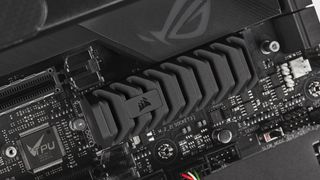
The quickest SSDs all leverage the PCIe 4.0 bus, but not all are created equal—in terms of rated specifications, it largely boils down to when they were released. Timing matters, because the first crop of PCIe 4.0 SSDs topped out at around 5,000MB/s. Past came a new round of memory controller hardware, which pushes speeds north of 7,000MB/s. Corsair's bran-new MP600 Pro XT falls into the latter class, while also boasting incredibly high IOPS.
This is Barbary pirate's quickest SSD to date. It's available in 4TB, 2TB, and 1TB capacities, and while specifications vary between the smallest and two biggest drives, all three are rated to deliver ascending to 7,100MB/s of consecutive read performance. Here's a snapshot of the relevant speed metrics:
- 4TB—7,100MB/s seq. reads; 6,800MB/s seq. writes; 1.2 million haphazard read IOPs; 900K random indite IOPS
- 2TB—7,100MB/s seq. reads; 6,800MB/s seq. writes; 1.2 million random read IOPs; 1 million random indite IOPS
- 1TB—7,100MB/s seq. reads; 5,800MB/s seq. writes; 1.2 million hit-or-miss read IOPs; 900K random write IOPS
The rated IOPS is where the MP600 Pro Crosstalk separates itself from the competition. Take for instance Sabrent's Arugula 4 Plus, one of the best SSDs for gaming. It offers upwardly similar sequential take (7,100MB/s) and write (6,600MB/s) specs, but the random read and write IOPS check in at 650,000 and 700,000, respectively. WD's SN850, another speedy SSD, hits 1 million IOPs for reads, only ranges between 680,000 and 720,000 IOPS (depending happening content) for writes.
This won't ever come into play—IOPS can dissemble performance when accessing a bunch of files that are scattered across the NAND flash memory chips. In terms of real-world usage, most users won't in reality notice more than of a difference, though it still speaks to the quality and capabilities of the NAND, controller, and microcode.
In this casing, Barbary pirate pairs Micron's 176-bed 3D triple-level cellular telephone (TLC) NAND store chips with the Phison's PS5018-E18 controller. It's the same comptroller as found on Barbary pirate's MP600 Pro (non-Crosstalk) discharged earlier this yr (and most of the fastest SSDs on the market), merely the NAND is an upgrade all over the 96-layer chips the non-XT models use.
In those terms it's actually identical to the Seagate FireCuda 530 we lately reviewed, which uses the homophonic NAND and controller, though is tweaked to deliver ever so-so-slightly high sequential carrying out in 2TB trim. The difference there is probable to come down to firmware.
We're putting the Corsair MP600 Pro XT through it's paces right today, just to see how it compares with Seagate's finest.
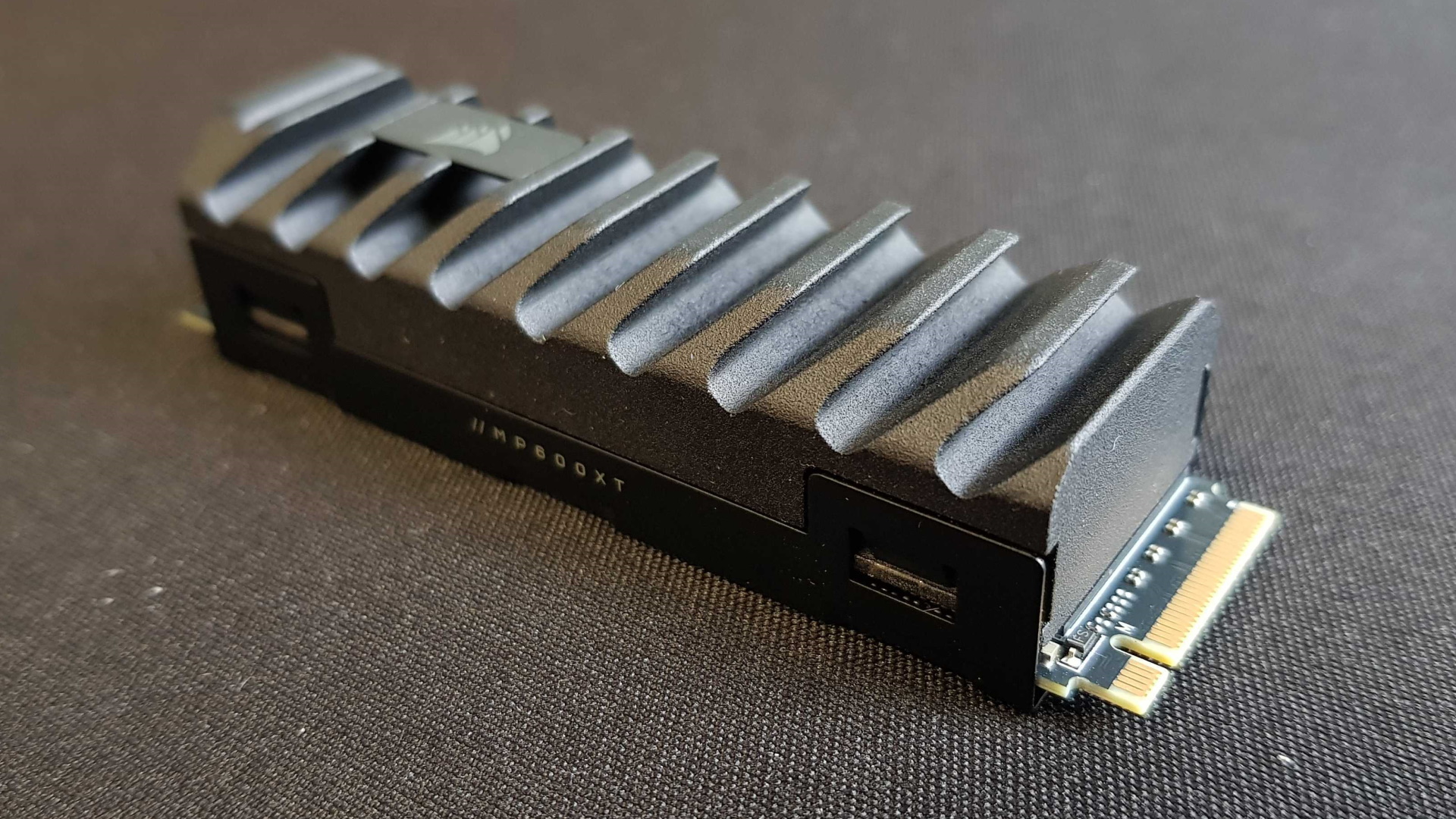
Barbary pirate also outfits its MP600 Pro XT with a "uniquely styled aluminum heatspreader" to keep toasty temps at bay. It's chonky for doomed, though is actually rather artful in the build. Additionally, Barbary pirate says its new drives are compatible with its Hydro X Series XM2 H2O block, if you want to incorporate 1 into your liquid cooling iteration.
The new drives are available now on Corsair's webstore, priced at $990 for the 4TB model, $400 for the 2TB drive, and $200 for the 1TB model. Not gaudy, though generally in line with other SSDs in the same speed class.

Paul has been playing PC games and raking his brass knuckles on hardware since the Commodore 64. He does not have any tattoos, but thinks it would be cool to start out single that reads LOAD"*",8,1. In his off time, he rides motorcycles and wrestles alligators (only one of those is dead on target).

Source: https://www.pcgamer.com/corsairs-thick-new-ssd-smokes-all-first-gen-pcie-40-drives/
Posted by: henrysuraceent.blogspot.com
0 Response to "Corsair's thick new SSD smokes all first-gen PCIe 4.0 drives | PC Gamer - henrysuraceent"
Post a Comment